Stars Without Number has this ingenious faction system for GMs to run the behind the scenes intrigue and conflict of major organizations in their sandbox campaign.
Has anyone done something with this, or something like it, in their own solo/solitaire games?
Hey guys back again! this time its to discuss my thoughts on listening to music while playing solo-RPGs and Gamebooks. Have a look and let me know your thoughts!
Looking back on some of my hand-written play records, everything’s a bit dry and lifeless. There’s enough description that I could go back and relive the moments, but the descriptions would be significantly less comprehensible to anyone else.
I wanted to share two links I’m looking at in my search for solutions.
Perhaps there’s some crossover between our communities already, but if you haven’t dropped in over there, I encourage you to take a look. Some people prioritize beautiful layouts, while others make clean, efficient ones. There are a lot of ideas to harvest there to take your session records in whatever direction you’d like.
This is just one of many overviews on the topic, but the basic idea was to make lecture notes more effective by visualizing connections and emphases using layouts and graphics. For hand written session reports, establishing a language of icons, containers, and connectors might look nicer than stream-of-consciousness paragraphs.
I haven’t tried any of the above ideas out yet (newborn in the house, what is free time anymore?), but if I do, I’ll make sure to share pics.
Check out my dice journey, from the early days of stealing monopoly dice for my Fighting Fantasy books to the crazy sets I use now for Gamebooks and Solo-RPG Experiences!!
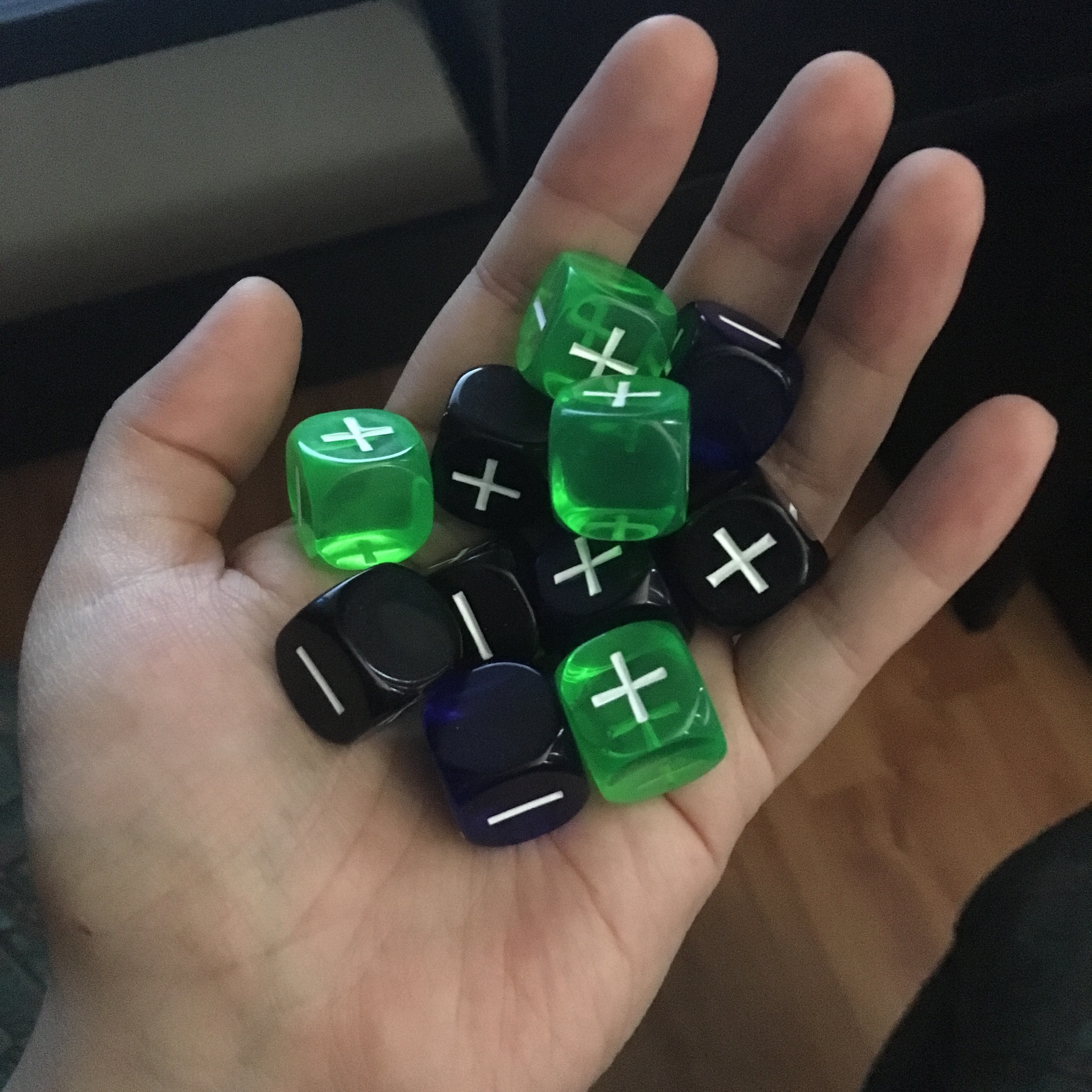
Ok, so I’ve decided to share the Fate/Fudge dice Oracle system, in case anyone needs it.
First and foremost, do you have any Fate/Fudge dice (Fd’s)? If not, you can easily create your own by taking a bunch of d6, a sharpie, and the image I’m including attached. It’s a cheap and easy solution that works just like the real deal!
Now, with your Fd’s ready, here’s the Oracle. You just need 2Fd’s for it. The meanings would be as follows:
+ + = Yes, and… (Or exceptional/critical YES!)
+ [] = Yes
+ – = Yes, but…
[] [] = No, but…
[] – = No
– – = No, and… (Or exceptional/critical NO!)
[] = a blank
Also, thanks to +Sam H’s suggestion, you could add another level of depth to your Oracle: Do you need to determine the level of probability of something happening? Roll 2Fd’s.
+ + = Very likely
+ [] = Likely
+ – = 50/50
[] [] = 50/50
[] – = Unlikely
– – = Very unlikely
If you obtain a Likely, roll the Oracle for a Yes/No and then move your result 1 level towards a more favorable result:
i.e A no, but… becomes a yes, but… if it’s Likely.
The Unlikely is the same as the Likely, except it alters your result towards a more unfavorable one.
A Very Likely result moves your Yes/No Oracle 2 levels towards a favorable result:
i.e A no, but… becomes a Yes if it’s Very Likely.
The Very Unlikely is the same as the Very Likely, except it alters your result towards a more unfavorable one.
A 50/50 result does not alter your Yes/No Oracle result.
Hi folks! Just really investigating solo roleplay for the first time, and eyeing off both Mythic and Libre engines. Can anyone offer a recommendation either way, or even for a different option?
Elena’s second face off with the Wan Brothers corp.
Still continuing to use concordances, but now I’m mixing that up with using a Bayesian formula to come up with the odds of some things given facts established in the fiction (or made up on the spot, as needed). Bayes comes mostly into play when I have some assumptions about how the flow should go but don’t want to fiat things, or when I’ve constructed a potential flow out of concordances I’ve collected.
I’ve asked a few questions about using Bayesian inference as an Oracle of sorts here and on RPGNet. I’m still not sure I’m doing Bayesian inference correctly, but at least it looks like I’m getting consistent numbers to roll against. Feel free to chime in about that if you have any ideas.


 Lone Wolf Roleplaying